
How to Organize a Deck Shuffleboard Group Night: Teams, Turns, and Pacing

Deck shuffleboard works well for a group because not everyone has to play at once. The challenge is organization: uneven skill levels, long conversations, food arriving mid-frame, and unclear turn order can slow the night. A simple team map and short-match format keep the floor safe while giving every interested guest meaningful turns.
For article 10 in this campaign, the reader’s job is to make a practical choice for an adult visit in or near East Las Vegas. This article does not promise a game result, advertise a temporary promotion, or guarantee a particular item, machine, broadcast, or event. Use the linked first-party pages when a current detail will determine the plan.
Confirm deck shuffleboard, not table shuffleboard
The venue activity uses cues and discs on a floor court, so equipment, stance, and scoring differ from puck play on a table. The point is not to make the evening complicated; it is to decide the few details that prevent confusion later.
- Court: Keep bags, chairs, and drinks outside the marked playing area.
- Cues: Use the provided equipment without swinging or lifting it unnecessarily.
- Discs: Wait until all movement stops before anyone enters the court.
- Rules source: Review the venue page and agreed house format before the first frame.
The order matters: start with court, use cues to narrow the choice, verify discs in the real setting, and keep rules source as the final guardrail. That sequence turns confirm deck shuffleboard, not table shuffleboard into a decision the whole group can understand.
While working through “Confirm deck shuffleboard, not table shuffleboard,” use Starboard Tack’s deck shuffleboard page as the first-party checkpoint. That page helps verify the part of this specific decision that can change instead of leaving the group dependent on an old search result.
Choose teams that keep everyone involved
Large teams can work when the order is visible and no one waits through an entire evening for a second shot. The point is not to make the evening complicated; it is to decide the few details that prevent confusion later.
- Balanced mix: Spread experienced and first-time players across teams.
- Three or four per side: Use smaller teams when the group wants more repetitions.
- Spectator option: Do not pressure guests who prefer to watch or join later.
- Captain role: One person tracks rotation, not every strategic decision.
These four checks work together rather than as separate rules. Balanced mix establishes the baseline, Three or four per side adds context, Spectator option prevents an avoidable assumption, and Captain role keeps the plan practical. If one check fails, revise the plan before moving on.
While working through “Choose teams that keep everyone involved,” use Starboard Tack’s Starboard Tack website as the first-party checkpoint. That page helps verify the part of this specific decision that can change instead of leaving the group dependent on an old search result.
Write the turn order once
A fixed sequence prevents the loudest player from taking extra shots. The point is not to make the evening complicated; it is to decide the few details that prevent confusion later.
- Visible list: Put first names in order on a phone note or small card.
- Alternate sides: Keep the agreed team rotation through the frame.
- Late arrival: Add the person at the next clean rotation point.
- Missed turn: Move on and restore the player in the following round.
A useful way to remember write the turn order once is to ask four short questions: What does visible list tell us? How does alternate sides change the choice? Has late arrival been confirmed? Does missed turn still fit the evening? Clear answers are more valuable than a rushed decision.
While working through “Write the turn order once,” use Starboard Tack’s current events page as the first-party checkpoint. That page helps verify the part of this specific decision that can change instead of leaving the group dependent on an old search result.
Use short matches or timed rounds
A compact format helps groups rotate without waiting for a formal game to reach a distant score. The point is not to make the evening complicated; it is to decide the few details that prevent confusion later.
- Score target: Agree on a modest finish before starting.
- Time cap: Use when food or an event creates a natural deadline.
- Best-of series: Only add another match if other teams are not waiting.
- Tiebreak: Choose one simple extra round rather than inventing rules mid-game.
The order matters: start with score target, use time cap to narrow the choice, verify best-of series in the real setting, and keep tiebreak as the final guardrail. That sequence turns use short matches or timed rounds into a decision the whole group can understand.
While working through “Use short matches or timed rounds,” use Starboard Tack’s current food and drink menus as the first-party checkpoint. That page helps verify the part of this specific decision that can change instead of leaving the group dependent on an old search result.
Teach safety and delivery before strategy
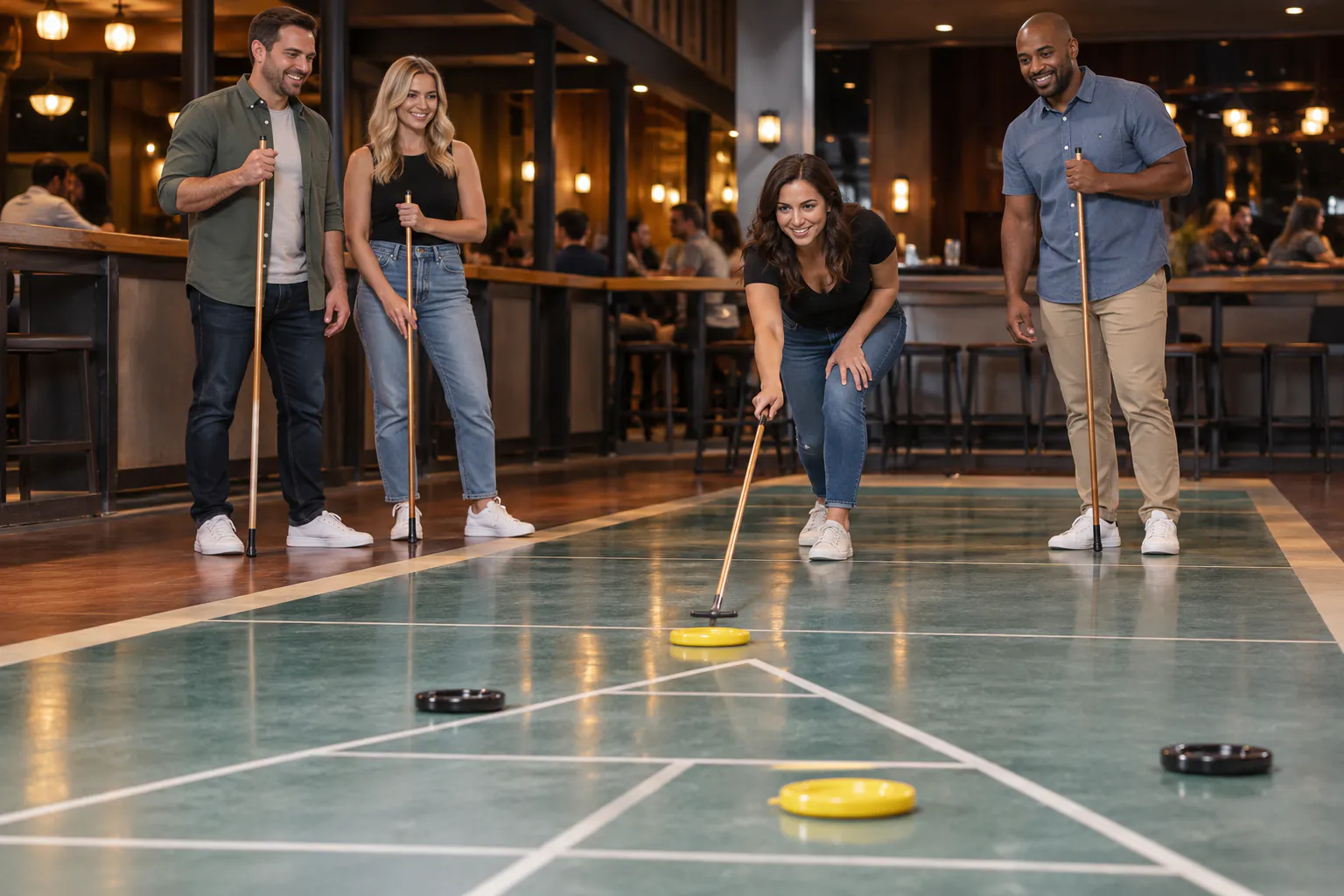
One demonstration of stance and cue control is more important than a long lecture about scoring angles. The point is not to make the evening complicated; it is to decide the few details that prevent confusion later.
- Clear lane: No one crosses while a player is preparing or shooting.
- Controlled push: Guide the disc along the floor instead of lifting or chopping at it.
- Stable stance: Keep feet balanced and avoid lunging into another player’s space.
- Retrieve together: Enter the court only after the frame is complete and movement has stopped.
These four checks work together rather than as separate rules. Clear lane establishes the baseline, Controlled push adds context, Stable stance prevents an avoidable assumption, and Retrieve together keeps the plan practical. If one check fails, revise the plan before moving on.
While working through “Teach safety and delivery before strategy,” use Starboard Tack’s contact and location details as the first-party checkpoint. That page helps verify the part of this specific decision that can change instead of leaving the group dependent on an old search result.
Coordinate food, drinks, and belongings
The best group-night logistics keep the court separate from the table. The point is not to make the evening complicated; it is to decide the few details that prevent confusion later.
- Order window: Place food orders before a match or between complete frames.
- Drink station: Use a stable table beyond the boundary.
- Clean hands: Protect cues and discs from sauces and spills.
- Personal items: Store coats and bags where players will not step backward onto them.
A useful way to remember coordinate food, drinks, and belongings is to ask four short questions: What does order window tell us? How does drink station change the choice? Has clean hands been confirmed? Does personal items still fit the evening? Clear answers are more valuable than a rushed decision.
Finish with an easy rotation plan
A group should know whether the next step is a rematch, new teams, food, or the ride home. The point is not to make the evening complicated; it is to decide the few details that prevent confusion later.
- Winner stays cautiously: Use only when it does not lock beginners out.
- Mix teams: Rebalance after a one-sided result.
- Last call for players: Announce the final match before people begin leaving.
- Safe exit: End early enough to settle tabs and confirm transportation.
The order matters: start with winner stays cautiously, use mix teams to narrow the choice, verify last call for players in the real setting, and keep safe exit as the final guardrail. That sequence turns finish with an easy rotation plan into a decision the whole group can understand.
Putting the plan into practice at Starboard Tack
For “how to organize a deck shuffleboard group night teams turns and pacing,” the local reference point is Starboard Tack at 2601 Atlantic St. in East Las Vegas. The official site describes food, rum and cocktails, bar-top video poker, deck shuffleboard, and events. Use only the parts relevant to this article, then match them to the current menu, hours, activity details, and the needs of the actual group.
Before using this shuffleboard plan, share the destination and identify the one fact that still needs confirmation for informational / local activity. Leave room for a late arrival, changed appetite, occupied activity area, or quieter pace. That flexibility is what makes the advice in “How to Organize a Deck Shuffleboard Group Night: Teams, Turns, and Pacing” usable outside a spreadsheet.
As a final check, explain the plan in one sentence without relying on the phrase “shuffleboard group night.” If the sentence still tells the group what to expect, when to arrive, and what must be verified, the plan is probably specific enough to use. If it turns into a claim about being the best, winning, guaranteed availability, or a temporary special, return to the official pages and revise it.
The responsible close for shuffleboard is simple: adults who drink or play video poker should set limits first, include food and water, and arrange safe transportation. Gambling remains entertainment rather than a way to guarantee income or recover losses. When the preset money, time, attention, or transportation limit for “How to Organize a Deck Shuffleboard Group Night: Teams, Turns, and Pacing” is reached, stop.